
For the first few decades of my career as an estate planning lawyer, I never heard the term “Family Office.” Over the last several years, the concept has gained traction. I first wrote about it in this blog five years ago, Every Family Needs Some Kind of “Family Office,” July 13, 2021 [click on this LINK to read it]. Since that time, the idea of a Family Office has expanded dramatically. There is no one-size-fits-all structure. I made that point in my post: “Every family needs to design the family office structure that’s right for it. There’s no cookie cutter for this, and no two will match. As Tom Rogerson [of GenLeg Co.] says: “If you have seen one family office, you have seen ONE family office.”
The Dallas Morning News ran a series of articles shining a spotlight on this phenomenon: “Inside the World of Family Offices” by Charlotte Kramon, July 21, 2026, as well as articles on July 13 and July 26. There are good reasons for all this attention. The Family Office plays a key role in managing finances, but beyond that it helps the family prepare next generations to handle wealth responsibly, address succession issues, and provide overall family governance. The concept is still somewhat in its infancy, but rapidly evolving. To that point, Kramon quotes me in her article: “’It’s very much a new invention, so we’re kind of feeling our way through this still,’ said Fort Worth estate planning attorney Marvin Blum. ‘I went to law school 50 years ago. There was no such thing as a family office. No one ever used that terminology.’”
Probably the first thing people think of when they hear about a Family Office is a place to manage financial needs—investing, tax, accounting, bill paying, insurance. But as the institution has evolved, the mission has broadened into legacy concepts like coordinating family meetings to identify the family’s mission and values, planning enrichment and education activities, preserving heritage, and engaging in exercises to build trust and strengthen relationships. In his article “How to Set Up a Successful Family Office,” David Ramli asserts: “Preserving generational wealth is as much about managing relationships as it is about managing assets…. Families usually create single family offices for three reasons: to preserve wealth across generations, to maintain peace between them or to uphold shared values for as long as possible…. The question you should be asking yourself is, ‘What’s the purpose of this wealth for me and my family? Before a family can manage its wealth, it must first learn to manage itself.” (Bloomberg, Dec. 1, 2025).
Alicia Adamczyk emphasizes this point: “Investment advice and tax planning are some of the cornerstone services typically offered, but a major function of any family office is legacy planning. Many are focused on not just wealth building, but on wealth preservation. To that end, they go to great lengths to prepare the next generation to inherit their family’s wealth. That can include teaching them the fundamentals on topics like investing and estate planning, using a wide range of forums—from family meeting to workshops to retreats—while also strengthening relationships between family members.” (“How Family Offices Became the Investment Powerhouses Behind America’s Wealthiest Dynasties,” Fortune.com, Feb. 13, 2025).
Scott Saslow tells the story of his father’s death and how the task of reshaping the family office fell on his shoulders. He engaged in a two-year effort, working with consultants and other family offices. Saslow confesses that he “made many mistakes along the way. So he wrote a book, hoping to help other families avoid the pitfalls:” Building a Sustainable Family Office: An Insider’s Guide to What Works and What Doesn’t. “My intent in sharing my own story and what I’ve learned is to help other principals hear in detail, in an open and honest way, how another family office started, grew, and was rebuilt a few times…. Each family—and, therefore, each family office—is unique, yet some of the themes are universal.” (“Scott Saslow Rebuilt His Family Office—Then Wrote the Book He Needed Beforehand,” Institutional Investor.com, July 18,2024).
In my post last week, I described my career journey from “all head” to “head and heart” estate planning. As I’ve infused my tax practice with a passion for helping families thrive, I’ve discovered the intersection between tax planning and legacy planning. Families who embrace both head and heart are ripe for some kind of family office to help coordinate the efforts. TIGER 21 founder Michael Sonnenfeldt cites legacy-building families as “one of the strongest arguments for establishing a family office, because only a dedicated structure can consistently align investments, taxes, trusts and legacy planning into a coherent whole…. [When it comes to] Family Mission: a family office can institutionalize legacy, education and philanthropy. Its ‘return’ may exceed pure financial metrics.” (“Lessons from an Entrepreneur on When to Build a Family Office and How to Protect Your Wealth,” Barron’s, May 15, 2026).
So where are we today in the evolution of the Family Office? It’s a good start, but there’s work to do. A UBS study reveals that “only 42% of family offices have a strategy for ensuring a smooth wealth transition to future generations. The root of the problem, it seems, is the difficulty family offices have managing the so-called ‘soft issues.’” (Michael Thrasher, “UBS: Family Offices Are Fumbling Their Own Generational Wealth Transfers,” Institutional Investor.com, May 31, 2023). What are the soft issues where family offices struggle? The first has to do with helping the family articulate their values. But there are three more. The J.P. Morgan 2026 Global Family Office Report reveals them:
- adopting a formal governance structure, reducing the risk of internal family conflict, with a mechanism to address such conflict when it arises,
- addressing succession planning, as 86% of family offices lack a clear succession plan, and
- engaging the next generations in the family office, preparing them to be responsible inheritors.
On this last point in particular, I expressed wholehearted agreement in Kramon’s Dallas Morning News article: “’Preparing the next generation is really critical, because if you don’t prepare for it, they’re going to be handed a loaded gun with no instruction manual,’ said Blum, the estate planning lawyer.” The Blum Firm welcomes the opportunity to help your family develop that “instruction manual.”
Marvin E. Blum
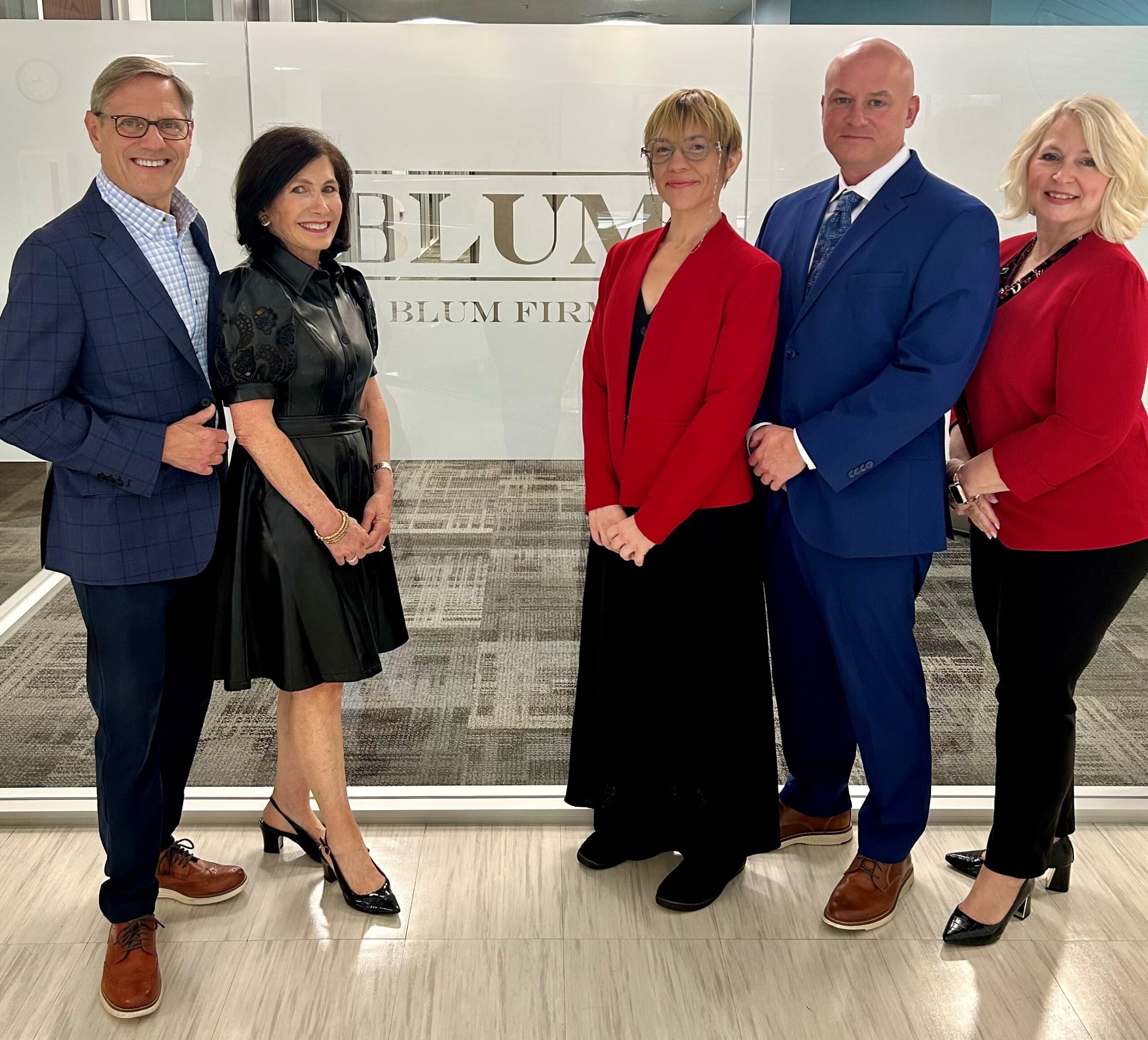
Marvin & Laurie Blum with key members of the Blum Family Office team Desiree Woods, Bryan Minhinnette, and Cat Bardin (left to right).