
I often describe my journey as an estate planning lawyer as traveling from a place that was all “head” to a “head and heart” destination. I went to law school 50 years ago, and the focus was entirely technical. I became a “tax man.” I even recall classmate Steve Willey, editor of a law school newsletter, describing me as “the nicest tax man around,” an oxymoron that meant a lot to me. For the first four decades of my career, living up to that “tax man” label was my goal.
Then I began witnessing some bad inheritance outcomes. My active tax planning was doubling the size of inheritances, but the money often seemed to be doing more harm than good. Throwing more money at unprepared heirs was adding fuel to the fire. That’s when I shifted into a “head and heart” approach to planning. I still embrace the head side, but I now couple it with a holistic viewpoint, helping families pass down not just valuables, but also values. “Head and heart” planning is not just money-driven, but also purpose-driven.
As my commitment to this “heart” side expanded, I began writing this blog on Family Legacy Planning. My mission with this blog was to share some tips on building and passing down a meaningful legacy. I thought I’d have run out of juice long before now, but somehow, I’m six years into it and have never missed a Tuesday post. I recently sent out my 300th post.
I say all this as a preamble to today’s message, because in this post I want to veer back into the “head” side. I do so without apology, as the head and the heart are intertwined. Neither “all head” nor “all heart” works well. The family needs both financial security and a strong legacy culture to thrive. It brings to mind the words of consultant Susan Stone when facilitating a Trinity Valley School strategic planning project: “No margin, no mission.” We were dreaming big with lofty goals for the school, and she brought us back to earth with the reminder that, without a profit margin, we’d achieve no mission. So, allow me to put on my tax hat today and let’s explore some techniques to save tax.
To save income tax, we utilize a mixing bowl partnership to scrape off the high basis from one asset and shift it to a low basis asset. Upstream planning involves a simple way to soak up an elder loved one’s unused $15 million exemption and step up the basis of your assets, through the use of a carefully designed general power of appointment (“GPOA”) inserted into your revocable living trust. We engage in swaps of high basis assets into a grantor trust, in exchange for low basis assets, in order to get a basis step-up upon death. We also optimize the benefits of Section 1202 Qualified Small Business Stock (“QSBS”) and through creative workarounds can avoid tax on $15 million to $750 million of gain upon the sale of a business. We developed a unique way to pack value into a Roth IRA. Other ways to save income tax include Private Placement Life Insurance (“PPLI”), as well as various charitable strategies.
To save the 40% estate tax, we turn to “squeeze and freeze” techniques. We start with the squeeze, transferring assets into a holding company like a Family Limited Partnership (“FLP”), achieving both asset protection and valuation discounts for lack of control and lack of marketability. We then turn to the freeze step, transferring your interest in the FLP to certain trusts like the Defective Grantor Trust (“DGT”) for your kids, the Spousal Lifetime Access Trust (“SLAT”) for your spouse, the 678 Trust or Beneficiary Defective Inheritors Trust (“BDIT”) created with a $5,000 gift from a third party to a trust for the benefit of YOU and your family, the Grantor Retained Annuity Trust (“GRAT”), and others. With careful planning, you can avoid the 40% federal estate tax (plus state inheritance tax), yet retain access, control, and flexibility. At The Blum Firm, we’ve succeeded in doing so hundreds of times, all with full transparency and no pushback from the IRS. In a recent case, the IRS even approved the estate tax return from a client where the planning we did saved over $1 billion.
Here’s the key point I have to stress. These opportunities are available today, under present law. However, as political winds shift, the window of opportunity may close. We dodged a close call in 2021 when Senator Bernie Sanders’ “For the 99.8%” legislation failed by two votes. A key takeaway from that proposed law was that it grandfathered anyone who had already engaged in the technique before the law changed. Regardless the outcome of the November mid-term elections, we may still have a two-year window to use all these tools, provided the President vetoes any legislation to raise taxes, but you never know what legislative trade-offs could arise. Senator Chris Van Hollen has already introduced the “Strengthen Social Security by Taxing Dynastic Wealth Act” (a clever title), reducing the $15 million exemption to $3.5 million for estates and $1 million for gifts, and raising the rate from 40% to 45%. Bernie Sanders has introduced a companion bill with even more changes. A word to the wise: don’t wait. Act now while the law is favorable.
I give a lot of speeches on this topic. Click on this LINK for a recent presentation on “Head and Heart” Estate Planning. In particular, note the Income Tax Strategies and Gift Planning Toolbox on slides three and four.
TIGER 21 founder Michael Sonnenfeldt emphasizes the importance of engaging in active tax planning in his Barron’s article of May 15, 2026. Sonnenfeldt stresses the difference between before-tax and after-tax returns. The measure that matters more is the after-tax outcome, the amount left in your pocket after paying Uncle Sam. He cautions against living with a pre-tax mindset, “because after-tax and after-estate outcomes diverge dramatically from pre-tax perceptions.” Sonnenfeldt wisely considers both the income tax hit and the estate tax hit. “Most of us live intellectually in a pre-tax world, but at a certain level of wealth, the measure that matters most is what reaches future generations.”
Here’s where there’s a convergence between the “head” side of planning and the “heart” side. Per Sonnenfeldt’s MUUSINGS Substack about living in an after-tax world, an after-tax mindset is especially valuable when it comes to philanthropy. “This is not simply a matter of being tax-efficient. It represents a more thoughtful approach to wealth stewardship—an intersection between financial prudence and moral responsibility. It allows you to redirect resources in a manner that reflects your values and commitments, AND do so by making scarce resources go farther through wise planning. Philanthropy done wisely extends your legacy far beyond financial success. What are you doing to prepare for the next gen?”
Visionary families pay attention to this intersection between tax planning and legacy planning. After five decades practicing in this area, it’s become my passion. I want to help families thrive, from generation to generation. We’d be honored to help you achieve that mission for your family.
Marvin E. Blum
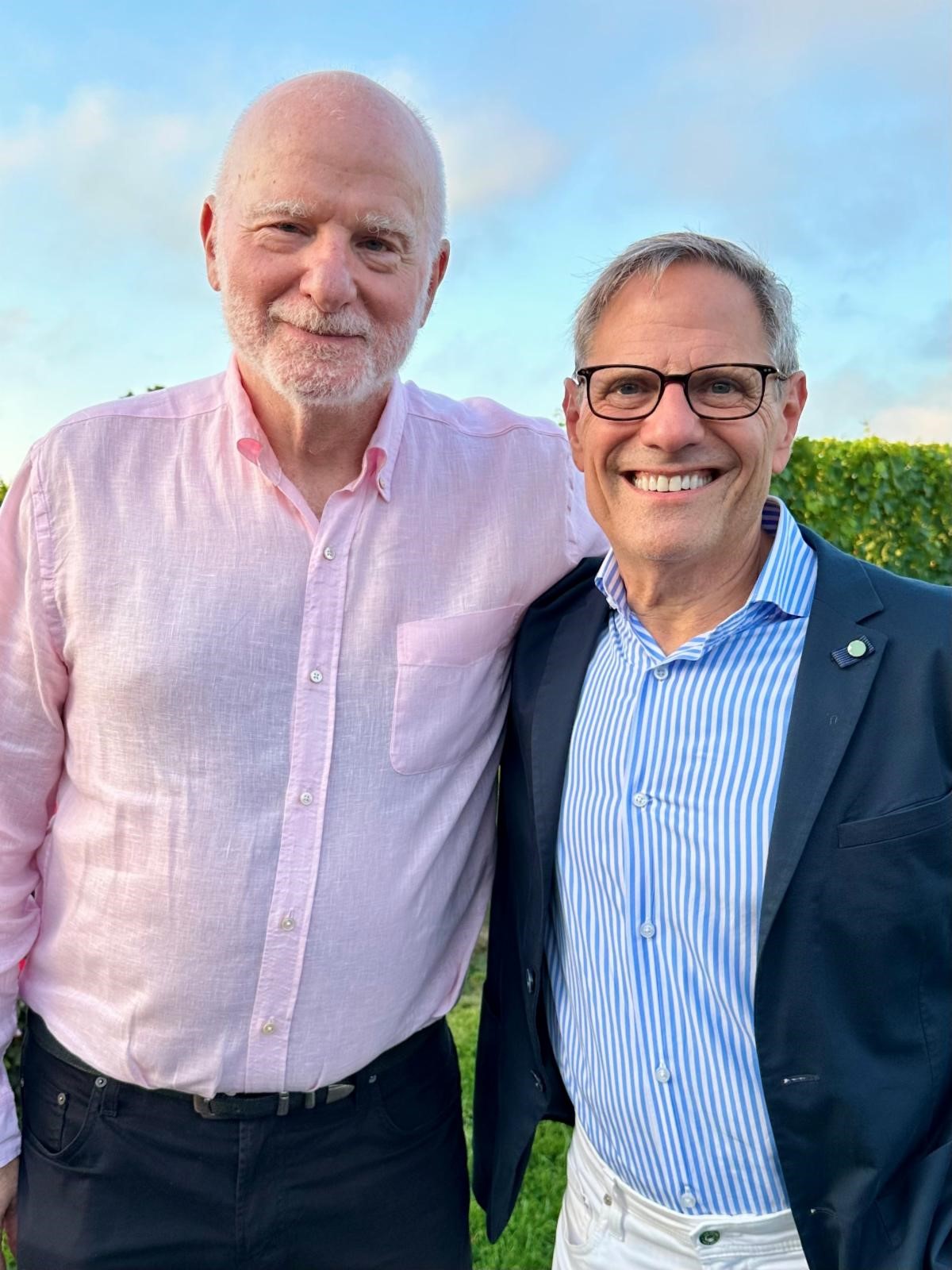
Marvin Blum (right) and Michael Sonnenfeldt share the view that after-tax returns matter far more than before-tax returns, especially when it comes to legacy planning.