
I have the honor of serving for many years on the editorial board of Trust & Estates magazine, a leading national publication in the estate planning field. The February 2026 issue features an article interviewing me, along with two other board members Jonathan Blattmachr and Avi Kestenbaum. The title is “Reflections from Our Board—Lessons Learned, What’s Changed, and Where Modern Estate-Planning Practice is Heading.” The three of us shared answers from our lengthy careers to questions posed to us by Trust & Estates editor in chief Susan Lipp. Here are some highlights of my responses.
Question 1: What are the top two lessons you’ve learned when working with clients?
I shared a couple of lessons I learned the hard way, from mistakes that became teachable moments for me. The first was to connect promptly with a new client and establish a connection, even if you can’t get to the work immediately. Early on, I lost a Fortune 500 CEO as a client by not responding to him fast enough. The second was a widow who needed extra hand-holding during her period of grief. I was doing her work but not reporting to her sufficiently on my progress, leaving the impression I was neglecting her. Fortunately, I salvaged it and we not only developed a close working relationship, but also a deep long-lasting friendship.
I also shared a lesson on the need to listen before offering advice. Many of our clients are dealing with difficult issues. Such as complicated family dynamics. Before I propose head and heart solutions like “squeeze and freeze” tools and FAST trusts, they want to be heard. We can then work together to tailor solutions to specific needs.
Question 2: What are the most significant changes you’ve seen in how your firm conducts business?
My answer contrasted the estate work from 50 years ago when I started (which was mainly comprised of doing a Will) with today’s holistic approach. Our toolbox now includes planning for incapacity, asset protection, minimizing tax, prenups, special needs trusts, charitable planning, business succession, elder law, legacy planning, family governance, a Red File, and more. As I said, “It’s not your daddy’s estate planning anymore.”
Question 3: Looking ahead, what do you anticipate will be the most significant challenge for estate planning attorneys?
My response focused on the pros and cons of technology advances. I started when fax machines and memory typewriters were the new things, and very long before cell phones. Now with Zoom and AI, we can work anytime, anywhere, and provide answers almost instantaneously. The downsides concern me—no time to disengage and recharge, losing the face-to-face connection, challenges of creating a cohesive law firm culture with remote workers. We need to be intentional to achieve a balance between technology and our well-being.
To discover my expanded answers and the replies of my two esteemed colleagues, click on this link to read the article. If you’re like me, you’ll be surprised to see that we express different viewpoints, with no overlap in our responses. I find the messages to be compelling. As Avi Kestenbaum said, “I really like and appreciate the wisdom here. Much of it applies to all areas of the law as well. This should be a must read for young lawyers and law students.” I agree.
Marvin E. Blum

Marvin Blum (center), Jonathan Blattmachr (left), and Avi Kestenbaum (right) are three members of Trust & Estates magazine editorial board featured in an article on lessons learned, changes in the profession, and the future of the estate planning practice.
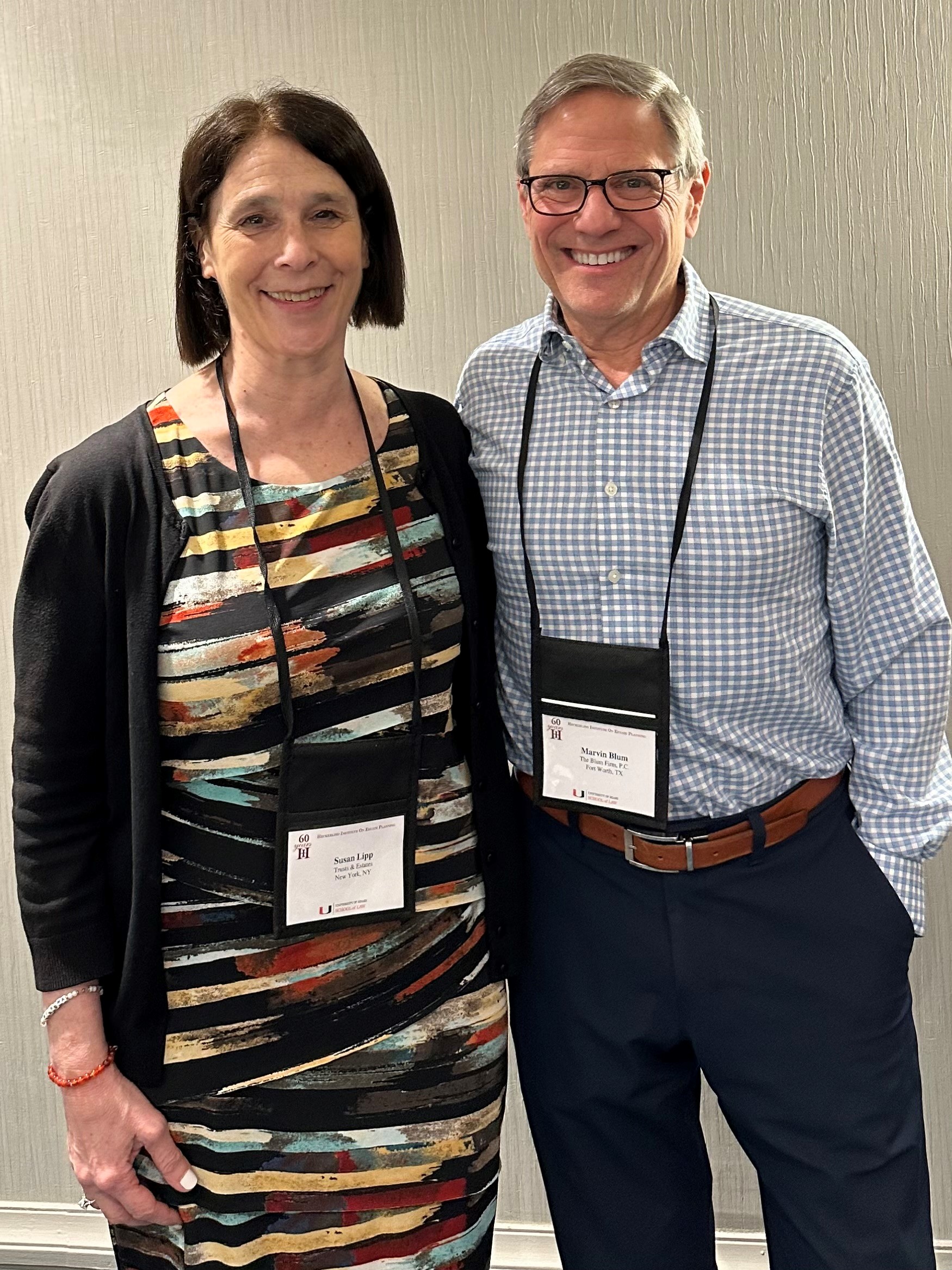
Susan Lipp, editor in chief of Trust & Estates magazine, with editorial board member, Marvin Blum.