
Growing up, I was what you would call a nerd (in today’s lingo). At school, I chose sedentary electives that worked the mind rather than the body. In seventh grade, I enrolled in wood shop and soon discovered it wasn’t my scene. I quickly switched to Spanish, a much better fit— muchas gracias! I also worked in the school library, on yearbook staff, and selected a typing class over sports. You get the picture. Young Marvin was a nerdy (and chubby) bookworm.
Looking back on my time in McLean Jr. High, one choice proved to be more clairvoyant than I’d have guessed at the time. I became a member of the McLean Mirror newspaper staff. Evidently, my lifelong perfectionist and obsessive tendencies were already on full display, as I was selected to be head proofreader. Moreover, I was assigned to write a column entitled “Musings from Marvin.” Who would’ve imagined that more than 50 years later, I’d still be writing that column, just under a different headline. This weekly Family Legacy Planning blog is essentially a continuation of my “Musings from Marvin” column.
I began reflecting on my writing path when reading Jim Collins’ recent book What to Make of a Life. Collins described how we are “encoded” early on with certain talents. We are usually unaware of that gift until one day when that talent outs. Consider this example: “Young Toni Morrison did not aspire to be a writer. She loved literature, she loved reading, she loved teaching about books. But she had no idea that she carried within her a constellation of encodings that, when snapped into frame, would make her one of the most significant novelists of the 20th century.”
After my stint as a columnist for the McLean Mirror, I took a long break from writing. For one thing, I never considered myself a good writer. That negative impression was reinforced by my high school English teacher Paula Eyrich. She was right, my writing was heavy and labored. I lacked confidence to just spit it out in a way that would be fresh and easy to read. Though my high school writing style was all wrong, there was still a writer lurking deep inside of me. The discovery of that encoding for writing came much later.
Collins describes others who shared a journey like mine, waiting for the moment when something would ignite that slow-burning inner fire that was always there. He described case after case when the flames of talent would start blazing later in life from “the seeds of early passions.” Collins’ research revealed “a useful method for reigniting the inner fire, especially in episodes of fog: the value of watering seeds planted earlier in life. Across the study set we found evidence of seeds planted early in life. In some cases,… those seeds lay largely dormant for years to decades, only to flower later in life.”
Collins continues: “This pattern of circling back to water early seeds led me to some useful questions for figuring out the next phase of life that will feed the inner fire: Do you have dormant seeds from earlier in life that, for whatever reason, you’ve never watered? These might be interests you’ve always had, but your life went a different direction.”
Collins teaches that you have to water those dormant seeds to make them grow. Inadvertently, the COVID pandemic provided me with the pause I needed to start watering my seeds. That’s when I started writing this blog. Over these five years, I’ve been actively watering my McLean Mirror seeds by writing week after week without a break. As my daughter Lizzy says, it’s like a muscle that gets stronger the more you exercise it.
Toni Morrison’s encoding was “snapped into frame” by her early efforts as a novelist. According to my best friend Talmage Boston, I have an encoding for helping people navigate life in a meaningful way, and “your blog has snapped that encoding in your system into frame with a laser focus.” Talmage regularly urges me to keep watering my seeds until they flower into a book. Who knows? Maybe “Musings from Marvin” could one day sit on some bedside nightstands.
As further encouragement, I’ll close with the teaching of Rabbi Harold Kushner, author of When Bad Things Happen to Good People. Per Rabbi Kushner, there are three things everyone should do: plant a tree, have a child, and write a book. That’s how you create a living legacy that will live on after you’re gone. Two down—one to go!
Marvin E. Blum
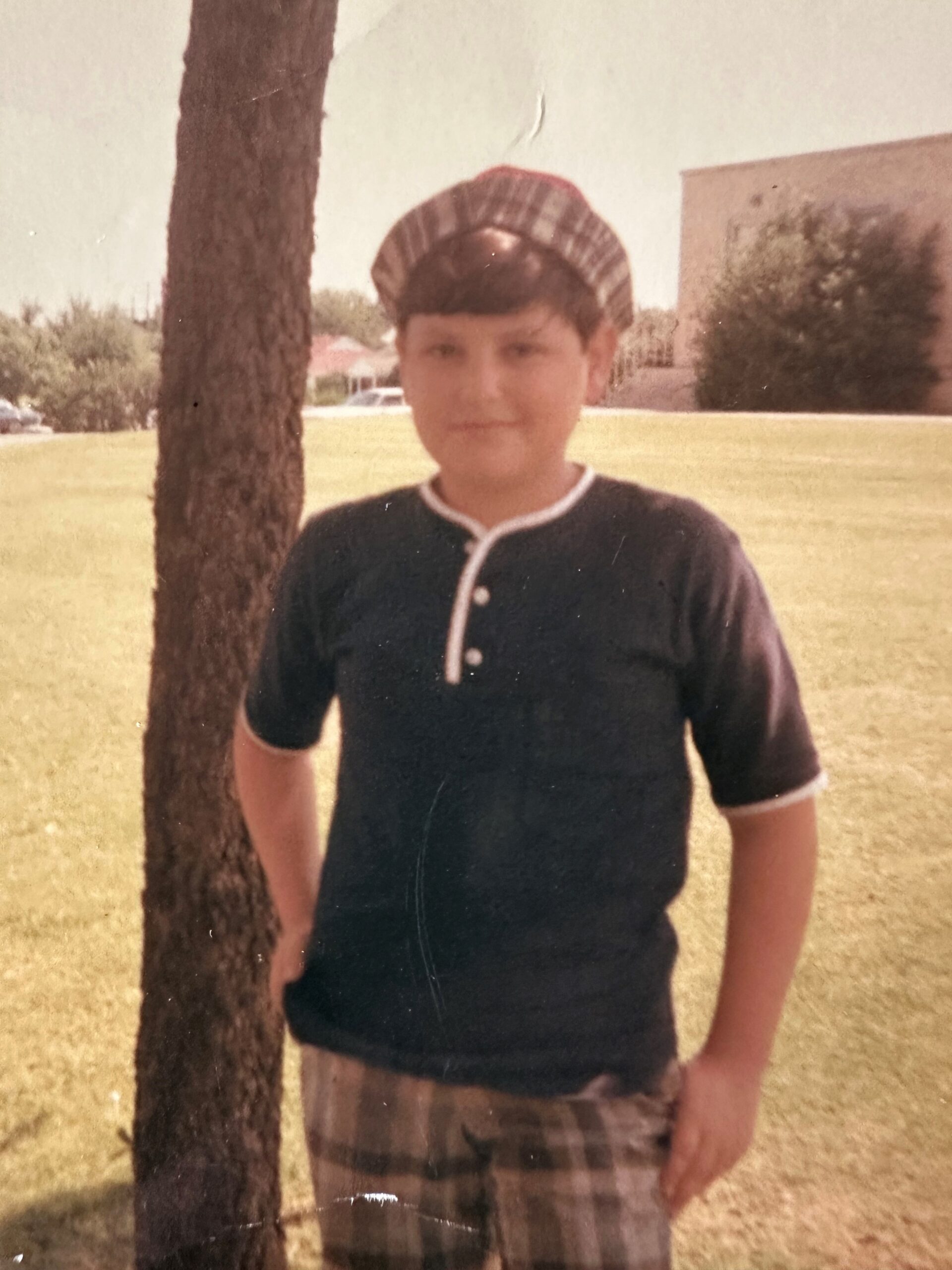
Marvin Blum in his junior high school days when early writing seeds were planted in him as a columnist for the McLean Mirror newspaper.